Who will win the Personal Agent War? Muse, Instinct, Dot, Cue or Grok Bot?
Personal agents have taken over the headlines of AI recently.
Instinct raises $1 billion at a $10 billion valuation. A roughly year-old startup, founded by 23-year-old Noah Shinn, becomes one of the hottest names in consumer AI.
Meta adds over $200 billion in market value after Muse's launch.
Poke got acquired by Cognition. ChatGPT launched Dot, Manus launched Cue, Grok has grok bot. Everyone wants to capture the personal agent share. Meta and ChatGPT have distribution across billions of users. Startups have the advantage of shipping fast and being innovative.
The race isn't just about who has the smartest model. It's about who earns the consumer’s heart with trust and reliability.
Poke Nailed the Personality. Instinct Nailed the Autonomy.
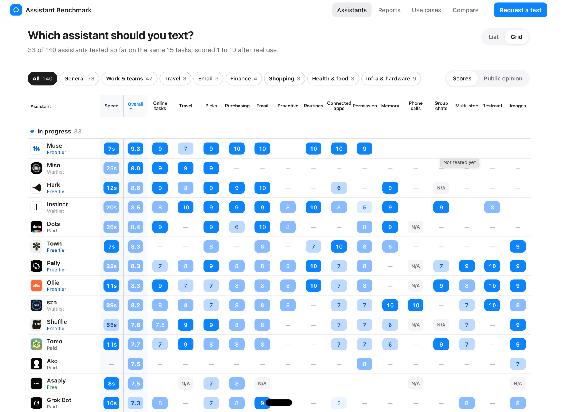
(an interesting comparison by assistant benchmark on personal agent)
I've been a huge fan of Poke for over a year for email summaries, reminders, and calendar invites. Living in Telegram makes it seamlessly part of my routine.
What makes Poke special isn't its intelligence, but its personality. Instead of lengthy LLM responses, it replies with "On it" or "Done." Short, playful, and surprisingly human.
Instinct takes this further with proactive assistance. Without setting up schedules, it monitors my emails and reminds me of important matters, feeling like a genuine 24/7 assistant. During my Japan trip, it even navigated Japanese websites to book restaurants and Mount Fuji bus tickets using my credit card.
Poke's early-mover advantage was proving that an AI could feel natural inside messaging. Instinct is showing a real 24/7 agent which can get complex tasks done.
Speed and Inference remain huge bottlenecks.
Nobody wants to wait 30 minutes for a simple task. From my experience, Muse is noticeably faster than Instinct, with speed influenced by model choice, inference capacity, and memory management.
Instinct's founder shared that compute demand was doubling weekly, making capacity planning a huge challenge. Too little compute slows agents down, while too much burns capital.
But inference isn't the only bottleneck. Browser agents still spend time taking screenshots, finding buttons, and clicking through pages, often requiring dozens of model calls for a single task.
I believe future apps will increasingly expose agent-friendly APIs instead of forcing agents to navigate human interfaces.
Today's agents are learning to use human interfaces. Tomorrow's interfaces will be designed for agents.
Memory can be a huge moat for personal agents.
The founder of Supermemory reverse-engineered Instinct's memory system and suggested it uses Git-tracked Markdown files to store personal context, relying largely on keyword search for retrieval.
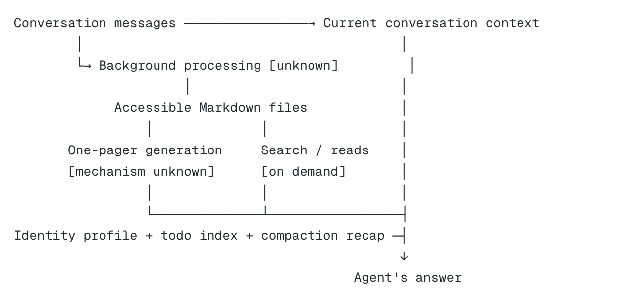
Muse takes a different approach with Active Memory, training the model to directly manage memory organization, retrieval, and compaction.
The key takeaway is that bigger context windows don't necessarily mean better memory. What matters is knowing what to remember, update, and forget.
I believe memory could become one of the strongest switching costs in consumer AI. Once an agent understands your habits, preferences, and relationships, switching means rebuilding months of context.
Do you trust a personal agent with your credit card?
Instinct reports that roughly 40% of users share a credit card within three weeks. I am one of them as I believe we are at the stage where LLM is not easily prompt injected and there is sufficient guardrail. But I do use a separate card and set active limits.
Muse's security architecture is impressive. Each user gets a dedicated virtual machine, an isolated cloud computer where the agent can browse, execute code, and maintain a persistent environment. Sensitive credentials sit behind additional security boundaries.
Strong security builds consumer trust, encouraging users to share more sensitive information with their personal agents. This makes agents more powerful and personalized, creating a flywheel of trust and better capabilities.
How to make money if a personal agent is free?
I believe personal agents need to be free or bundled into existing AI subscriptions like ChatGPT. Most consumers won't pay for yet another subscription. Instinct raised billions with reportedly zero revenue, while claiming to be approaching $1 billion in annualized transaction volume, nearly half from travel.
Instead of relying on subscriptions, Instinct is exploring merchant-funded transactions, where businesses pay agents for bringing them customers. Today, businesses compete through SEO and ads. Tomorrow, they'll compete to be the option an AI recommends.
But there's an obvious conflict. If Hotel A pays a higher commission than Hotel B, will your agent still recommend the better deal? Agent commerce risks replacing sponsored search results with sponsored decisions. Without transparency, monetization could undermine the very trust that makes personal agents valuable.
The War Isn't Really About the Model
Poke has an early-mover advantage in messaging and personality. Instinct is pushing proactive autonomy and browser execution. Muse brings frontier models, dedicated infrastructure, and Meta's enormous distribution. ChatGPT is catching up with the launch of dot recently.
Each is approaching the same problem from a different direction.
At Pokee AI, we build enterprise AI agents that are being deployed on-prem or on-device and the deeper engineering challenge is always combining speed, model, inference, memory, security, browser execution, and permissions into an agent that works reliably with security.
The real milestone isn't when an agent can do everything. It's when you trust it enough to let it.
Get new posts by email
An email whenever I publish. Unsubscribe anytime.
No comments yet