Jev: Overhype or breakthrough?
When Jev first blew up online, I was wondering what's the difference between that vs any small, fast LLM model that outputs json. I decided to dive deeper after seeing how they have raised $870 million at a $7.5 billion valuation.
Jev has sparked excitement around System 1 AI. Cloudflare released its open source version CLEF post trained on Qwen claims to perform better weeks after. OpenAI released its own decision API as well.
Tldr: Jev is not necessarily investing in a new breakthrough in model, but bringing a new perspective where AI is designed to be consumed by software, not just humans.
How is JEV different from LLM/Classifier model?
The idea of System 1 and 2 actually originated in cognitive psychology where System 1 refers to fast thinking, like JEV’s probability-based classifications, while System 2 refers to slower thinking, like reasoning LLMs.
There is 3 key distinctions between JEV vs standard LLM/classifier model
- It is ultra cheap at 400x less the cost.
- It is ultra fast at 200x speed. This is particularly valuable for time-sensitive decisions, such as trading, where large amounts of data need to be processed and decisions must be made in milliseconds.
- It gives exact probability of decisions unlike LLM they can say yes or no but they wouldn't be able to give an actual probability as it is trained by RLCD instead of RLHF or RLVR.
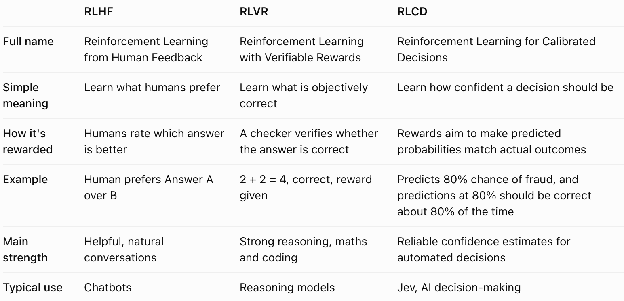
But at the end of the day, it is wrong to compare JEV with LLM as JEV can never answer a simple question like “why is sky blue” The key distinction is that LLMs generate explanations, while Jev predicts and evaluates outcomes.
Jev is the first and others are catching up
Several companies are exploring similar ideas through different technical approaches.

Cloudflare Clef builds on Qwen with specialized decision heads and post-training techniques, scoring options without generating text.
Interfaze Lev adapts Qwen3.5-4B using LoRA and extracts probabilities directly from model logits in a single forward pass.
Perplexity pplx-decider extends structured decision-making to multimodal inputs.
Some approaches modify model architectures, while others adapt existing open-source models. Jev's underlying architecture remains proprietary.
The shared idea is simple: not every AI task requires generating language.
How does JEV actually create Real Value?
Imagine a company handling 100,000 customer support tickets daily. Instead of using an expensive LLM for every ticket, Jev could quickly classify requests, assess urgency, and decide which ones need human attention.
The same applies to fraud detection, cybersecurity, and financial trading, where fast decisions matter.
What interests me most is its potential for AI agents.
Today, agents often use powerful LLMs for everything, even simple decisions like choosing between read_file and search_web. Do we really need a frontier model for that?
A better approach might be to use small decision models like Jev for simple tasks, LLMs for complex reasoning, and traditional code for execution.
The question is whether the savings in cost and time outweigh the extra complexity of adding another model.
Final Thoughts
I don't think Jev's significance lies in whether it invented a fundamentally new form of machine learning. Much of what it does has existed in different forms for years.
What makes it interesting is the shift in perspective.
For the past few years, we've largely measured AI progress by how intelligently models respond to humans. But the much larger economic opportunity may come when AI is embedded directly into the software we use every day.
System 1 models aren't necessarily smarter than traditional LLMs. They're optimized for a different purpose, and they could make entirely new kinds of software economically practical.
The next big leap in AI might not come from making models smarter, but from making AI fast and affordable enough to power millions of everyday decisions.
Get new posts by email
An email whenever I publish. Unsubscribe anytime.
2 Comments