AI's Real Bottleneck Isn't Chips. It's Power.
Two years ago, the AI race was about who could get the most GPUs. Today, Nvidia says it can make every chip the market wants. The problem is that there is nowhere to plug them in.
The US power grid has grown less than 1% a year for two decades. In 2024, China added about 429 GW of new power. The US added 51 GW. Between data centers, EVs and factories coming home, the US needs roughly 80 GW of new supply a year and builds closer to 50-60 GW.
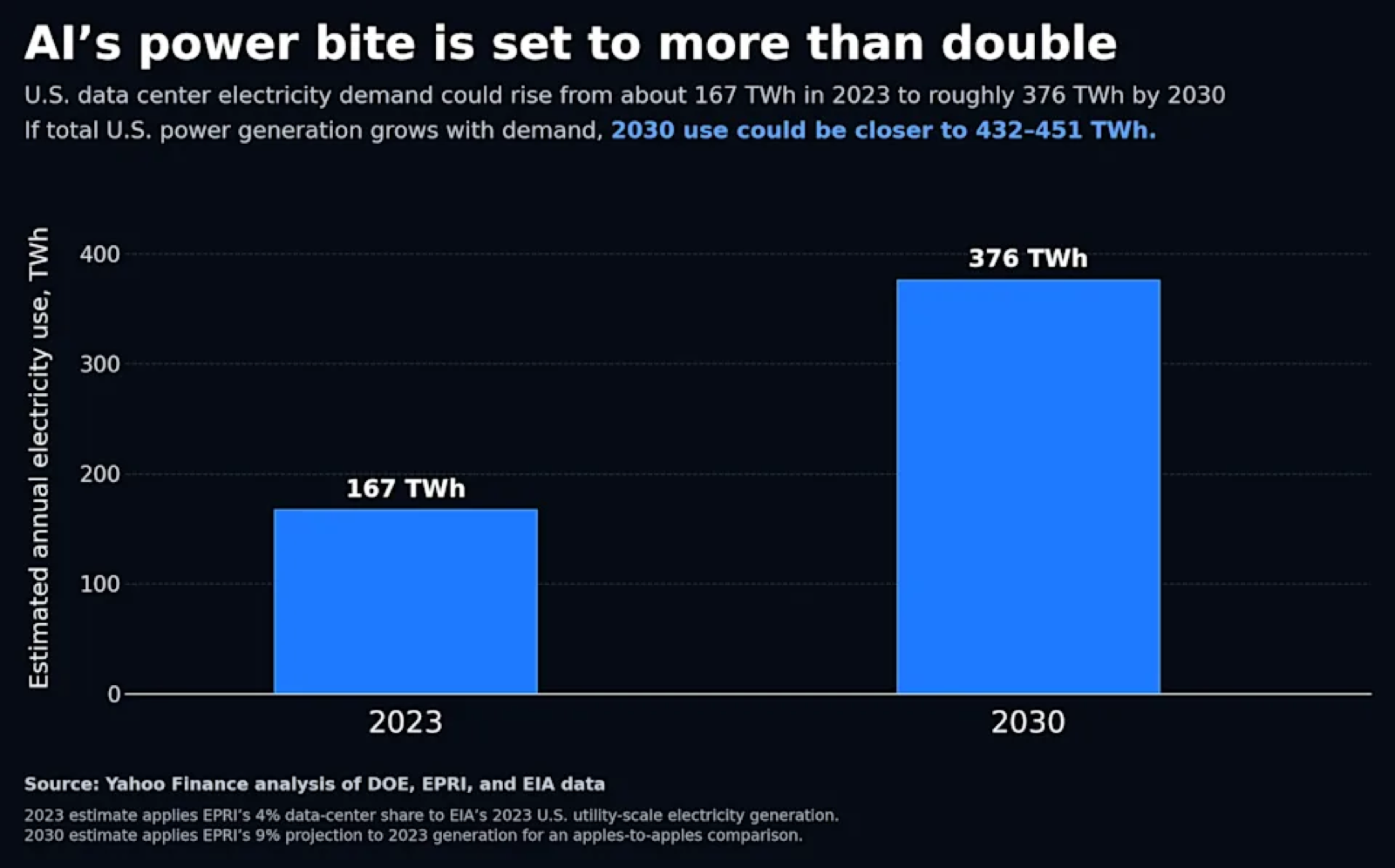
TL;DR: The AI bottleneck has moved from chips to electricity. Whoever can turn a megawatt into working compute fastest wins, and Wall Street is now lending trillions to make that happen.
In my last article, I covered how inference engines squeeze more tokens out of each GPU. This one goes one layer down: the energy and money underneath the whole stack.
Follow the Money: What Anthropic's S-1 Reveals

Anthropic's IPO filing is the first time anyone outside a frontier lab could see the real bill. The short version: an AI company is really a compute company with a model on top.
Compute is the biggest cost, by far. For every dollar Anthropic earns, about 57 cents goes straight to chips, data centers and power. In a normal software company, salaries are the big cost. Here, they're a side note.
Most of that compute isn't serving you. Only about a quarter goes to answering customers. The rest goes to research and training the next model. That's the hidden tax of staying at the frontier: you're always paying to build tomorrow's product while selling today's.
It works like an airline. An airline leases planes years ahead and pays whether the seats are full or empty. Anthropic books compute 12-18 months before it arrives. Book too little, and you turn customers away or buy last-minute capacity at a premium, which is exactly what flipped its profit into a loss last quarter. Book too much, and you pay for empty seats. In total, it has promised nearly $900B of compute spending, stretching out to 2045. but the golden rule is over-invest is better than under-invest due to competition.
Its suppliers are also its rivals. Amazon, Google and Microsoft rent Anthropic chips, invest in it, resell Claude to their own customers, and build competing models. So Anthropic spreads its bets across Nvidia GPUs, Google TPUs and Amazon's chips, and now plans to run its own data centers under "Anthropic Direct."
And buried in the risk factors is the scariest line of all: getting power to those buildings on time.
The Full Stack, From Electrons to Tokens
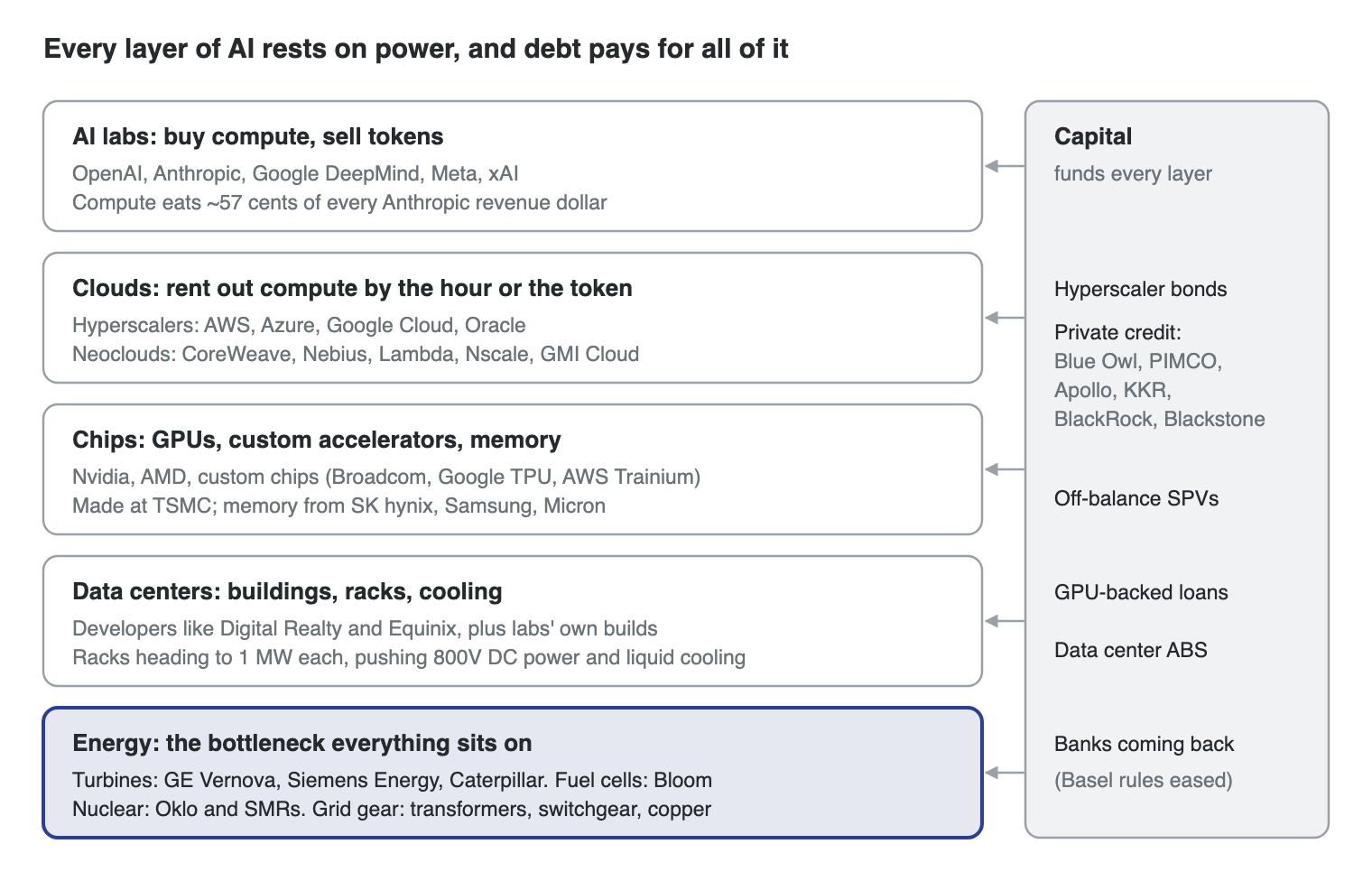
Each layer depends on the one below it. Labs pay clouds, clouds pay chipmakers and landlords, and every building needs a power connection that doesn't exist yet. Hyperscalers like Microsoft and Google often play every role at once, while neoclouds sit in the middle. Money from bonds and private credit flows into every layer, which is why a problem at the bottom ripples all the way up.
Why Power Is the Floor
A data center needs more than a power plant. It needs the whole chain: generation, high-voltage transmission, and local distribution. In the US, the middle part is broken.
Building a new long-distance power line takes 7-12 years. Every line crosses hundreds of private landowners, and each one can say no. It is the same reason America can't build high-speed rail.
So in the past year, the industry quietly gave up on the grid. The new playbook is behind-the-meter: build your own power plant right next to your data center. People inside hyperscalers estimate 30-50% of data centers planned this year use on-site power.
| Fix | Speed | The catch |
|---|---|---|
| Large gas turbines (GE Vernova, Siemens Energy) | Years | Sold out to ~2028. GE built only ~70-100 a year, vs ~4,000 jet engines |
| Small and jet-derived turbines (Caterpillar) | Months | Less efficient. xAI bought up most of the US stock; Colossus 2 runs ~160 of them |
| Fuel cells (Bloom Energy) | 60 days to 6 months | ~3x the upfront cost of turbines, and unproven at gigawatt scale |
| Nuclear (restarts, SMRs like Oklo) | 2028-2030+ | The only clean 24/7 option, but slow |
| Solar + wind + batteries | Fast to build | A solar GW delivers ~25% of its rating on average, vs ~85% for gas |
The hidden choke points are boring:
- Transformers: 18-24 month lead times. They need special electrical steel, and the US has one maker.
- Air permits: burning gas on-site needs EPA approval. A project not yet permitted is roughly 16-17 months from "token ready."
- Copper: Nvidia's next racks pull up to 1 MW each. At today's 54V, one rack would need ~200 kg of copper, so Nvidia is pushing 800V DC power inside data centers to cut losses from ~22% to under 1%.
- Politics: Local opposition is the new headline. Before the midterms, politicians from Texas down turned against data centers. Even the FAA now limits sites near airports.
The result: a large US data center takes 2-2.5 years from signing to compute. Industry insiders expect 10-20% of planned capacity to slip by a year or more, mostly delayed, not canceled.
Neoclouds: The Landlords of AI
If AI labs are the tenants, neoclouds like CoreWeave, Nebius, Lambda, Nscale and GMI Cloud are the landlords. They don't build models. They buy GPUs, find buildings with power, and rent the compute out.
Why do they exist when Amazon and Google already run clouds? Speed. A hyperscaler serves its own AI needs first. A neocloud's only job is to turn power into rentable GPUs as fast as possible. Right now, almost every buyer will take capacity, big or small, as long as it arrives before 2027.
The best explanation of their business I've heard came from GMI Cloud's CEO. Picture a glass you want completely full, because an idle GPU still costs money:
- Pebbles are long, multi-year contracts. They fill half the glass and keep the lights on.
- Sand is short-term rentals that fill the gaps.
- Water is the leftover: spare and backup machines nobody rents, sold as tokens through an API.
That's why every neocloud is drifting toward selling tokens, not just GPU hours. A cloud is a utilization business, and tokens are the finest grain of sand.
The catch is the same one every landlord has: you borrow to buy the building before the tenants move in. The strongest neoclouds have long contracts with top-rated tenants. The weakest are betting that cheap money and demand both hold up.
The Risks People Miss
Delay, not a bubble, is the real near-term danger. Data centers planned last year are due in 2027-2028, so most problems haven't surfaced yet. A delay rarely kills a project. But the loan interest keeps running while the building sits dark, and the revenue it was supposed to earn slips a year.
Fixed costs, flexible revenue. Labs sign decade-long compute contracts, but most of what they earn is pay-as-you-go. If usage dips for a few quarters, the bills don't.
The money goes in circles. Nvidia invests in companies that buy Nvidia chips. Clouds invest in labs that rent their clouds. When the same few players are buyer, seller and lender, it gets hard to tell real demand from money moving between friends.
The bull case is real too: demand is showing up as actual cash. Microsoft's cloud just grew 43% in a single quarter. If pain comes, I expect a shakeout, not a collapse.
My Take: Tech Is Turning Into Real Estate
For 20 years, tech was the easiest business on earth. Write code once, sell it a million times, keep the cash, buy back your stock. No factories, no land, no debt.
AI flips that. The frontier is no longer just a smarter model. It's land, power hookups, buildings and 20-year contracts. Big Tech has nearly stopped buying back its own stock because the cash now goes into concrete. And for the first time in a generation, it's borrowing heavily to build.
Once you see AI as real estate, a lot of strange things start to make sense:
Location is everything. A plot with a power connection is worth far more than an identical one without. That's why sites go from hot to dead state by state as local politics shift, and why more capacity is heading to Asia and the Middle East.
Renting beats owning, at least on paper. Like a retailer that leases its stores instead of buying them, Big Tech increasingly lets private funds such as Blue Owl and Blackstone own the data center, while it signs a long lease. The debt sits on someone else's books, even though the tech company is still the one paying it back.
The building outlives what's inside it. A data center lasts 20+ years. The GPUs inside are outdated in about five. That's the oddest part of this boom: long-term mortgages backed by short-lived chips. It works only if each new generation of chips earns enough to keep paying rent.
Where I think it goes:
- "Speed to power" becomes the main moat. Ready power stays the scarcest asset in tech through at least 2028.
- AI labs become infrastructure companies. Anthropic Direct and OpenAI's Stargate are the start.
- The boring stuff wins quietly. Turbines, transformers, switchgear, power chips and copper get paid no matter which model wins.
- The first casualties will be over-stretched neoclouds, not Big Tech. Landlords with weak tenants and expensive loans go first.
The release valve is efficiency. If power is fixed, the only way to grow is more tokens per watt. The next decade belongs to whoever turns electricity into intelligence most efficiently, not whoever buys the most GPUs.
The Last Frontier: Data Centers in Space
If the ground can't deliver power, why not leave it? In orbit, solar panels get sun around the clock at 8-10x the efficiency of the ground, and heat radiates straight into -270°C space. SpaceX merged with xAI and has filed plans for up to a million satellites. Google's Project Suncatcher sends its first TPU prototypes up in 2027. Starcloud has already trained a small model on an H100 in orbit.
The catch: a 1 GW space data center needs millions of square meters of panels and tens of thousands of tons in orbit, costing hundreds of billions. Hardware can't be repaired, and orbit is getting crowded. My view: space becomes a supplement for training jobs that don't care about latency, probably in the 2030s, not a fix for today's power crunch.
Get new posts by email
An email whenever I publish. Unsubscribe anytime.
No comments yet